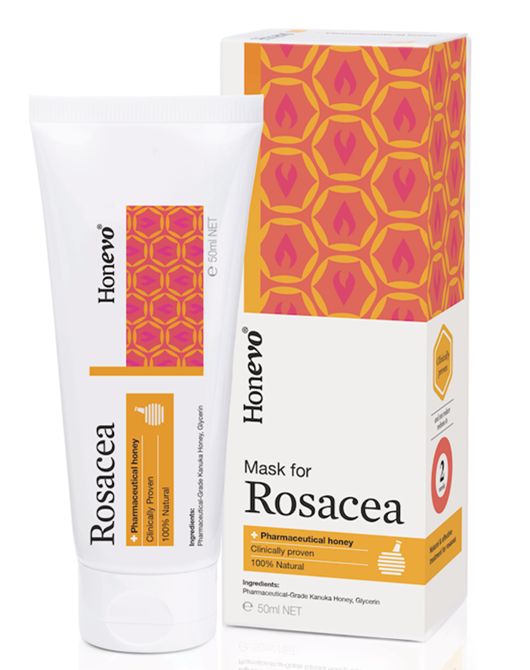
How to use it
- Apply as a mask to the affected area, twice daily
- Leave on for at least 15–30 minutes — longer is better, and it can be left on for several hours
- Wash off with warm water
- Continue until symptoms have gone, and restart if they return
- Store at 10–25°C
Ingredients: Honevo® (pharmaceutical-grade kānuka honey, glycerine). 50ml.
How it works
Kānuka honey has several properties that act on inflamed skin at once:
- Anti-inflammatory activity. This is why we use kānuka rather than manuka — manuka does not share it.
- Osmotic effect. A concentrated sugar solution leaves little free water available, making it a poor environment for micro-organisms.
- Hydrogen peroxide. Released slowly on contact with skin, with antiseptic properties.
- Acidity. Honey sits at pH 3.2–4.5, which further discourages microbial growth.
- Antioxidants. Bioflavonoids and other antioxidants may contribute to its activity.
The glycerine makes the formulation less sticky than raw honey and keeps it temperature-stable, so it stays consistent whether warm or cold.
What the trial found
138 people took part in a randomised controlled trial run by the Medical Research Institute of New Zealand, comparing the kānuka honey formulation against a placebo cream over eight weeks.
- 65% of participants improved
- 34% improved substantially
- 13% cleared completely, against 2.9% of those using the placebo
- Improvement was visible at two weeks and had increased by the end of the study at eight weeks
Fingleton J, et al. A randomised controlled trial of topical kanuka honey for the treatment of rosacea. BMJ Open 2015;5:e007651.
Trial registration ANZCTR ACTRN12614000004662. Read the paper
How that compares. The improvement Honevo® showed over placebo is of a similar size to the improvement topical metronidazole — a standard prescription treatment — shows over placebo in its own trials. Comparable results, from a natural formulation, without a prescription.
That comparison is drawn across separate studies rather than from a head-to-head trial, so we offer it as context. Participants were followed for eight weeks, the length of the study.